Proposal for a tool to analyse prospective scenarios
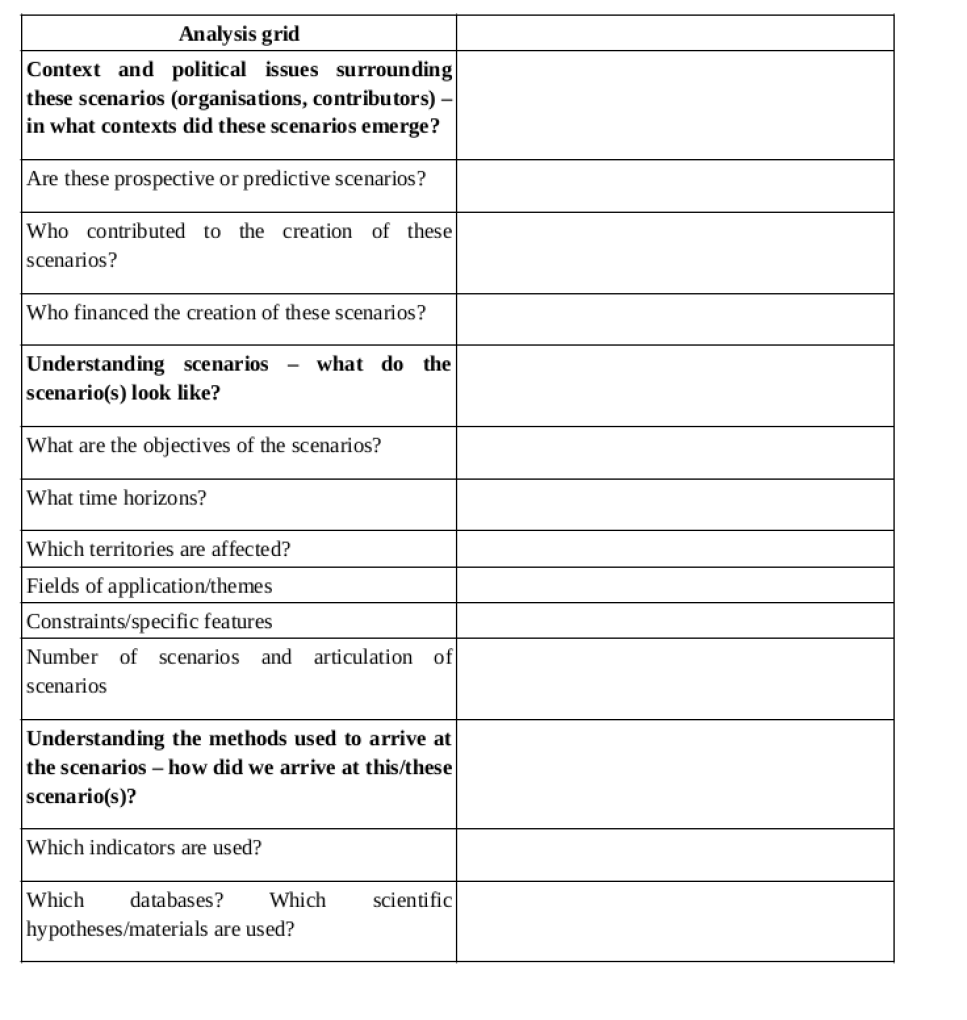
It can be difficult to navigate all these scenarios, understand their differences, their respective challenges and their potential links. Given the coexistence of these numerous works on prospective scenarios, we propose an analysis grid consisting of three main parts.
Proposal for an analysis grid
Each category in the analysis grid allows you to quickly identify the ins and outs of the scenarios, as well as their challenges, biases, blind spots, and strengths/specificities.
Context and political issues of these scenarios – what are the socio-political issues that influence these scenarios? The aim here is to examine the ins and outs of how these scenarios were developed. Each scenario is inevitably influenced by those who designed it, so understanding the context in which they were created can help to better identify the issues that shaped them.
Understanding the scenarios - what do the scenarios look like? The aim is to understand the content of the scenarios using criteria related to their objectives. Understanding the aspects of these scenarios can provide a better understanding of what is covered/not covered in these scenarios and what is being targeted, and this can be a good criterion for comparing different scenarios with each other.
Understanding the methods used to arrive at the scenarios - how did we arrive at this scenario or these scenarios? This involves understanding the methodologies used to arrive at these scenarios, and therefore grasping their blind spots as well as their strengths.
Fundamental :
The analysis grid allows scenarios to be examined using criteria that help to formalise the issues involved in the scenarios, their ins and outs, their biases and limitations, and their strengths and specific features.
This grid also makes it possible to compare scenario approaches in order to understand their significant differences and commonalities.