Socio-environmental situations
"Climate and geopolitical chaos, rising inequality and sea levels, erosion of soil and civil liberties, mass extinction of species and vernacular cultures, etc.: after decades of skilfully orchestrated blindness, the awareness that our civilisation is hurtling towards disaster is now widely shared. We are sawing off the branch we are sitting on, and we know it. Yet there is no sign of a change of course or a slowdown on the horizon, except in the form of a general collapse. We are content with cosmetic changes, repainting the existing system green in the hope that technology will solve all the problems without us having to reverse course [...]"
Terre et Liberté, La quête d'autonomie contre le fantasme de délivrance - Aurélien Berlan
Climate change has numerous consequences: rising temperatures and heat waves, more intense and frequent climate disasters, precipitation disruption, increased ocean acidity, etc.
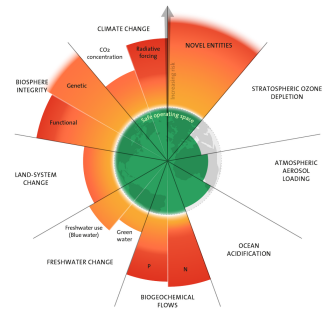
While climate change is one of the most widely publicised environmental issues, it is not the only socio-ecological concern and is one of nine other planetary boundaries.
About the 9 planetary boundaries model
The 9 planetary boundaries model was first published in 2009 by the Stockholm Resilience Centre. One of the main objectives of this model is to move beyond the vision of finite resources in order to take into account the limited capacity of ecological regulatory mechanisms. Each ‘boundary’ represents thresholds that must not be exceeded in order to preserve the biogeochemical processes that enable human habitation on Earth (climate change, biodiversity, etc.). In 2025, it is estimated that 6 out of 9 boundaries have been exceeded, leaving only ozone depletion (secured thanks to major successes in international and environmental cooperation) and ocean acidification as boundaries that have not been exceeded. It should be noted that atmospheric aerosol load is a boundary that cannot be quantified at this time.
These findings are therefore alarming, and the urgent need to change our socio-political trajectories by transforming our modes of production, consumption, living and working has been described as necessary for more than fifty years by numerous scientific bodies (Club of Rome, IPCC, IPBES, etc.).
About the Dounut Theory :
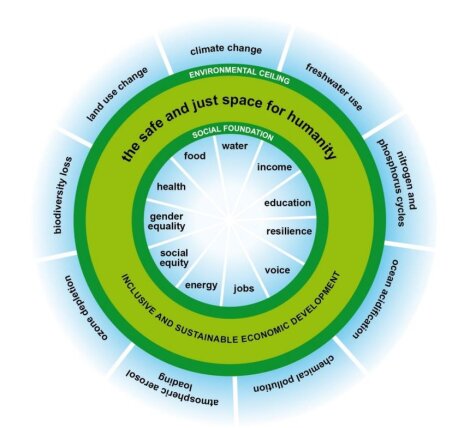
The planetary boundaries model – which focuses on environmental issues – can be complemented by the Donut theory, which adds social dimensions to this concept.
This concept is based on a transcription of the nine planetary boundaries, symbolised by the environmental ceiling that must not be exceeded, coupled with minimum social objectives that must be achieved in order to reach a social floor that allows for fair and secure living conditions for humanity. Kate Raworth, the economist behind this concept, contrasts this model with an economic model aimed at infinite growth.
Extra : To learn more about the Donut Theory:
Note : Semantic clarifications
In this module, we will not use the term ‘sustainable development’. This concept has been the subject of much criticism, with some critics denouncing it as greenwashing because they claim that:
This concept seeks to ‘green’ economic growth, rather than challenge the neoliberal capitalist economic model that has caused numerous socio-ecological disasters.
It is seen as incompatible with planetary boundaries, as it is based on unlimited growth in a world with finite resources.
It may lead people to believe that all growth is compatible with socio-ecological objectives, thereby diverting attention from necessary systemic changes by legitimising harmful production and consumption models.
Thus, in this module, we aim to provide tools for approaches rooted in the framework of planetary boundaries and the Donut theory, rather than sustainable development.
Extra : Scope of this module
The aim of this module is not to provide an exhaustive list of all the approaches and tools available to promote socio-ecological transformations, but rather to focus on issues related to imaginaries and prospective scenarios in the context of engineering approaches.