From the need to find useful tools... to prospective scenarios
About the systemic approach
The Donut Theory illustrates this well: in order to bring about societal change so that the Earth system is habitable for humanity and provides fair living conditions, many parameters must be taken into account. These parameters are all linked and interconnected.
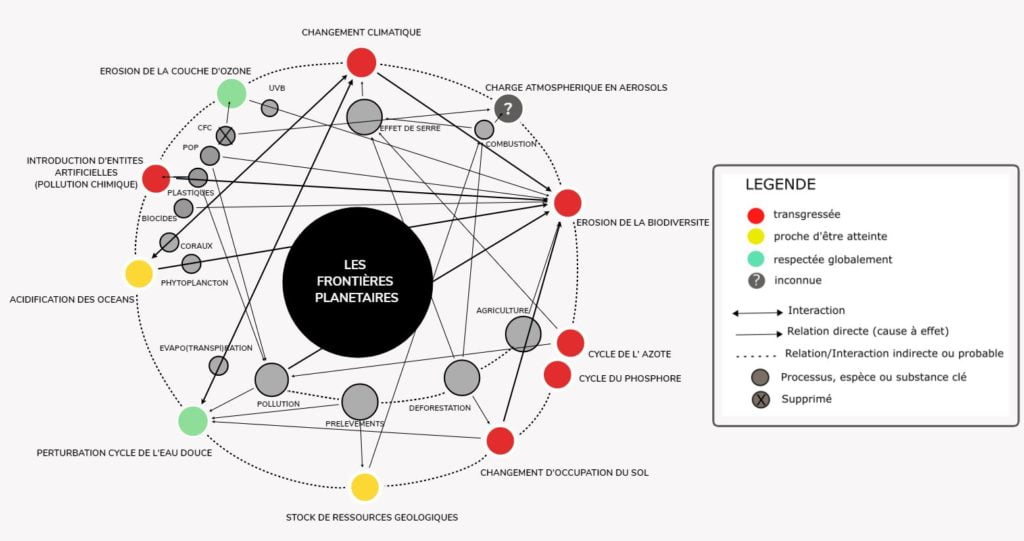
This diagram from Ex Naturae illustrates the links between planetary boundaries. While the details of the nature and intensity of each link are unknown in this diagram, it is already clear that understanding the dynamics of the Earth system illustrated here is difficult. The functioning of this system is unpredictable, unstable and non-linear. In other words, it is complex.
Each planetary boundary (such as climate change or biodiversity) is in itself a complex issue to study and understand. In addition, each of these boundaries is linked to the others in different ways. It is important to recognise this complexity with humility, because a simplistic and compartmentalised approach would be partial, insufficient and risky in terms of understanding these issues and guiding how to address them.
Definition : Systemic approach
One approach that may be relevant for understanding these issues is the systemic approach.
‘The systemic approach represents a real break with traditional methods of analysis. Whereas the classical approach divides, isolates and analyses each element separately, the systemic view considers phenomena as dynamic and interconnected wholes.’
« L’approche systémique : Comprendre une méthode globale et innovante » https://www.cerf.fr/lapproche-systemique-comprendre-une-methode-globale-et-innovante/
This approach allows us to consider a system as a whole, in a comprehensive manner, by focusing on the relationships and interactions between the elements of that system.
For example: it means not considering climate change as the only important ecological issue, but also taking into account the eight other planetary boundaries.
Focusing on the interactions between the elements of a system provides a better understanding of how a system works and its dynamics.
For example: it means considering planetary boundaries as interacting systems that impact each other in heterogeneous and unpredictable ways, rather than as separate, unconnected issues.
Example : Difference between an analytical approach and a systemic approach
"To understand the systemic approach, imagine you are watching a dance. You could focus on each dancer individually, analysing their movements one by one. Or you could take a step back and observe the choreography as a whole, seeing how the dancers interact, how their movements respond to each other and create overall harmony. This second way of observing perfectly illustrates what the systemic approach is: a method that invites us to take a step back to understand phenomena in their entirety."
« L’approche systémique : Comprendre une méthode globale et innovante »
The systemic approach is therefore valuable because it attempts to integrate the complexity of socio-ecological issues. Furthermore, it focuses on interrelationships and interactions. This implies accepting uncertainties that are impossible to fully predict and control, and therefore adopting a humble stance.
Extra : To learn more about the systemic approach:
Fundamental :
We are currently facing a world where the situation regarding resources, planetary boundaries and social issues is catastrophic, alarming and increasingly serious. To address the complexity of these issues, a systemic approach may be necessary.
But then, what should we do?
There is no miracle solution. There are no simple, foolproof actions that can address these systemic, complex and interconnected issues. However, there are methods, approaches and tools that can fuel reflection and guide action in favour of socio-ecological issues.
They are always imperfect and biased, but they are nevertheless necessary and useful for guiding questions, reflections and courses of action. There are many tools available, in different formats and with different purposes, which can promote action on socio-ecological issues. These tools may be complementary or, on the contrary, incompatible.
Among these tools, prospective scenarios provide frameworks for projections about the future. These scenarios can promote the transformation of our societies by driving and guiding individual and collective change.
Seeking to respond to socio-ecological crises in order to implement solutions and change the way we produce and consume is complex and leads to numerous obstacles. These obstacles can be technical, financial or legal in nature. Sometimes it is the former that spring to mind. But they can also be psychological, social, and cultural. Indeed, one of the obstacles that can quickly arise is a lack of vision and imagination about how a truly ecological, social, solidarity-based, and democratic society would function.
What does an ecological and solidarity-based society look like in concrete terms? How do people get around, feed themselves, work and go on holiday? Are they happy with a lifestyle that embodies socio-ecological values?
How can we imagine a world that would be different? Where should we start to bring about change, and what types of societies should we build?
These questions can be important in outlining courses of action because: how can I put energy into changing systems and taking action if I have no idea what kind of future I want to build?
To explain in more detail what we mean here by obstacles, we will use a fictional example of transition in the transport sector to understand how cultural barriers can come into play.
Example : Considering the transition of the transport sector: numerous obstacles at play
Let us suppose that we want to consider the transition of the transport sector in mainland France in a city.
Based on the observation that the production and use of combustion engine cars must be reduced, it is feasible and possible to think of solutions for changing car engines. However, it is more difficult to consider changes on a larger scale in terms of changes in individual habits and changes in transport infrastructure. There are various obstacles that could slow down developments in the transport sector with regard to cars. Let us suppose that we want to change the way people travel within a city, with changes in usage targeted at issues related to cars.
In engineering, one might think of the following types of brakes:
From a mechanical engineering perspective:
Designing and manufacturing electric vehicles is not necessarily difficult. But thinking about the transition of the transport sector is not simply a matter of replacing an engine. We need to seek to design mobility solutions, which is a more complex task. Creating an electric car that can be shared between several users, pooling batteries between different uses, increasing range by rethinking functions... The tools and methods commonly used by engineers are the legacy of a way of thinking that focuses more on the product than the service it provides.
From an urban systems perspective:
Having access to technically operational electric cars is not enough to integrate them into a region. Indeed, if we assume that elected officials decide to focus on a transport policy that promotes electric cars, there are many technical issues that need to be agreed upon: where and how should electric charging stations be installed? How can we consider modal shifts if we favour soft mobility? Added to this are significant financial and time constraints. Developing infrastructure requires financial and human resources, and above all, time. And yet, we are only talking about the ‘electric car’ system; if we were to integrate transport issues related to cyclists and pedestrians, the challenges would be even more complex.
And there are also deep-rooted cultural barriers that come into play:
From a psychological/sociological perspective:
Technical changes alone are not enough to transform travel habits, as there are issues of social acceptability and changing habits that involve inertia to change. For example, if a citizen is used to travelling by car for all her journeys, even if she is convinced that this mode of transport needs to change and that new infrastructure promotes soft mobility, it will take her time and energy to change the way she travels.
From a collective imaginary perspective:
Owning a car is highly valued socially because it is associated with success. Socially, it seems more desirable to own your own car than to use public transport
The individualistic and competitive culture values access to a car for oneself (and therefore does little to encourage initiatives such as carpooling or car sharing)
Novelty is valued (buying new cars rather than used cars is a symbol of economic success)
And the symbol of social success is not limited to owning your own new car. It also has to be a large one
Obviously, these formulations are simplistic, and the reality of cultural narratives is much more complex than that, but the intention was above all to illustrate how social norms can impact choices, often unconsciously. To explore this topic in greater depth, a report by R.A.P (Résistance à l'Agression Publicitaire) published at the end of 2024, entitled « Stop à l'automobile : La voiture à l'assaut de notre imaginaire - R.A.P (Résistance à l'Agression Publicitaire )»[6] (=Stop the car: Cars invading our imagination), explores the impact of car advertising on our imaginations.
There are therefore a whole host of imaginary components that influence mobility choices. The fact that the car is a socially valued mode of transport in certain cultures is not neutral. This means that in order to devise and implement systemic changes in transport, it is important to study these cultural barriers so that they can be taken into account and other alternative imaginaries that seem desirable can be introduced.
The barriers to change are therefore very varied and operate in different ways, which means that in order to address them, it is necessary to mobilise not only technical, legal and financial levers, but also cultural, social and psychological ones.
Projections into the future can be frightening and paralysing...
Becoming aware of all these obstacles and abandoning the idea that there are miracle solutions means confronting the complexity and systemic nature of the issues we face.
All this can seem overwhelming and impossible to overcome. Looking to the future, accepting so many uncertainties, and being clear-headed about current and future socio-ecological disasters can be frightening. Having no idea what a desirable future might look like, we may conclude that it does not exist, and this thought can be paralysing and prompt questions that fuel a posture of learned helplessness: What is the point of trying to take action? Do I really have the power to influence the world? Isn't everything already ruined?
...prospecting can help to co-construct these possible futures.
There are ways to break out of inaction and learned helplessness. Forward-looking scenarios can be tools that open up new possibilities, as imagination allows us to think outside established frameworks and existing barriers to change. Given the difficulty of imagining desirable futures in concrete terms, scenario work focused on socio-ecological issues can provide material for exploration, offering perspectives on the future that differ from the current system.
Prospective scenarios are useful tools for co-creating desirable futures, as they open up the field of possibilities and offer projections to strive towards.