Imaginaries are omnipresent in our societies and shape them.
Links between acquired impotence and action through the imagination
According to Pierre Peyretou, acquired powerlessness can be conceptually represented by the triangle of inaction. It illustrates the process of disempowerment employed by citizens, businesses and the government. Each component of the triangle shifts responsibility onto the others.
In reality, although the components of this triangle of inaction may appear compartmentalised, each individual is composed of a plurality of identities (citizen, worker, consumer) and can therefore act on each part of the triangle. There are many resources available to inspire, guide and encourage action, whatever the sphere of action (citizen, professional, consumer).
The lack of desirable and alternative scenarios is often a stumbling block when it comes to finding ways to do things differently and thus break out of attitudes of disempowerment and learned helplessness.
If it seems conceivable, accessible and desirable to work towards different societies – more ecological, more democratic, more united – then perhaps it is easier to envisage taking action and thus taking responsibility?
Extra :
To learn more about learned helplessness and eco-anxiety/eco-lucidity:
Pour un soulèvement écologique - Dépasser notre impuissance collective[1]
For more information on possible courses of action, see:
Definition : What is imagination?
According to Wikipedia: "The imaginary can be broadly defined as the product of the imagination of an individual, a group or a society, producing images, representations, stories or myths that are more or less detached from what is commonly defined as reality. "
The concept of the imaginary is therefore very broad and encompasses many different types of imaginaries.
An imaginary world can take various forms:
At first glance, an imaginary world may refer to fictional universes: Harry Potter, The Lord of the Rings, Star Wars, etc. But imaginary worlds do not only include fiction; they also involve individual and subjective representations of common concepts (see the example ‘imagine a house!’).
Imaginaries also encompass invisible social narratives, which may appear neutral and normal, but which are in fact highly structuring and impactful on our societies and depend on certain cultures. For example, earning a lot of money is considered an indicator of success according to certain social norms of 21st-century Western culture. This narrative is part of a capitalist worldview, where accumulating financial capital is considered a good thing. Each imaginary can construct and convey value systems, collective identities, and ways of forming society: it is in this sense that we consider an imaginary to be neither neutral nor without consequence.
Example : Imagine a house!
When asked to ‘imagine a house’, one might imagine, for example, that:
A person thinks of a very simple drawing of a house:

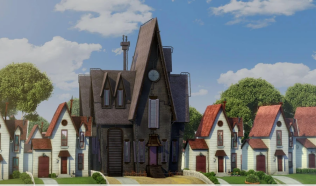
Another might think of a house she saw in a cartoon (in this case, Gru's house from the film Despicable Me):
Another thinks about her stereotype of what an architect-designed house is:

And another thinks about its own house

These examples illustrate that each individual has their own imaginative universe, and that behind common notions there are always individual and unique projections. Taking an interest in the imagination of an individual or a group, and their value system, can provide a better understanding of how they function and how to overcome certain barriers to change that could be removed by the power of stories and imagination.
Definition : Semantic clarifications
As the term ‘imaginary’ has many meanings, we propose a definition of it to distinguish it from other terms that we will use later: narratives, scenarios, and myths.
The imaginary refers to a set of individual and/or collective representations, more or less unconscious, that shape our perception of reality.
Narratives are forms of stories (real or imaginary) that can convey a message or worldview. They are narrative forms linked to one or more imaginaries.
Scenarios are structured projections of futures that are more or less desirable and more or less plausible. They can be prospections (seeking to explore possible futures, without necessarily seeking to predict what will happen) or predictions (seeking to predict what will happen, often based on past data).
A myth is an imaginary construct that seeks to explain the cosmic, psychological and social phenomena of certain fundamental aspects of the world and the society that forged or conveys it. Myths refer to sets of beliefs and idealised representations around a character, phenomenon, historical event or technique, which give them particular strength and importance.
'It should be noted that a climate projection is an estimate of future changes in average or extreme weather conditions. Unlike weather forecasts, climate projections are not intended to predict weather conditions on a given date and for a given location, but rather to estimate the probabilities of observing a particular change over a period of time (usually 20 years), in a given prospective scenario and for a given region."
Carbone 4, https://www.carbone4.com/publication-scenarios-ssp-adaptation
Imagination is omnipresent and shapes our societies...
Nancy Huston, in her book L'espèce Fabulatrice (The Fabulist Species), asserts that everything is narrative. Narratives are everywhere, from the way we recount our day, to the way societies are structured around religious narratives, to the way economic systems function on the basis of narratives.. : "Money is a fiction: little pieces of paper that have been decreed to represent gold. Gold is a fiction. In absolute terms, it is worth no more than sand. The stock market is a gigantic fiction." (Nancy Huston)
The omnipresence of our narratives constructs social norms, which in turn condition and structure the ways in which we form societies.
Example :
If we continue with the example of money, we can see that an entire market economy is based on narratives. One of these narratives is the belief that a piece of paper, depending on whether it says ‘20 euros’ or ‘50 euros’ on it, is worth different amounts, when physically it is just a piece of paper. This narrative is very structuring, because nowadays it would be difficult to imagine paying for a coffee in France with potatoes. Money, its forms and modes of exchange, is based on narratives that condition the way we interact and act on the world.
... And are also characteristic of the human species.
According to Nancy Huston and Yuval Noah Harai, one of the characteristics of human beings is that they construct themselves through the meaning of their stories: "Stories give our lives a dimension of meaning that other animals do not have. For this reason, I will henceforth capitalise this meaning. Human meaning differs from animal meaning in that it is constructed from narratives, stories and fiction." (Nancy Huston)
"The imagination is not only, as one might think, fiction, dreams or illusions; in a way, it is also like the root system of human societies. According to anthropologist Maurice Godelier, the imaginary is made possible by an exceptional cognitive function: imagination."(Rapport de l'ADEME "Mobiliser la société à travers le prisme de l'imaginaire")
Thus, no narrative is neutral.
Each narrative produces different meanings and has different implications for reality. Every narrative is marked by interpretation, invention, subjectivity and consistency within a given socio-technical system. "To speak is not only to name, to give an account of reality; it is also, always, to shape, interpret and invent it."(Nancy Huston)
Example : The texts of laws
The study of legal texts demonstrates the complexity arising from the different possible interpretations of a term in a legal text and its semantic power. A large part of legal studies in France consists in particular of understanding the different possible interpretations behind a term, what the existing interpretations of a legal text are and their applications in the past (case law). Our human societies are therefore structured around terms and narratives whose interpretation is plural and subjective and which require clarification to ensure common understanding.
Example : Imagination and consumption
Another example of powerful imagery is that of consumer society. One of the foundations of consumer society is to create needs in order to encourage consumption. Thus, the narrative that it is desirable to go on holiday far away is part of a very complex system of communication via advertising, films, the media and television, which convey the idea that one must travel far away, that this is a path to happiness and an indicator of social wealth.
"On the one hand, imagination can be used to distract us from reality, keep us inactive or even acclimatise us to the worst. This imagination is one of escape, abandonment and distraction. We are often in a consumerist relationship here, and our imagination is mostly contemplative and guided. It is a standardised imagination that captures our attention through spectacle or immersion. Neutral or apolitical in appearance, this type of imagination nevertheless perpetuates the vision of dominant narratives, existing value systems and established social norms. It can be shared widely in society through short videos on social media, series on streaming platforms, advertisements, etc."(Rapport Mobiliser la société à travers le prisme de l'imaginaire[8])
Example : Performative fiction
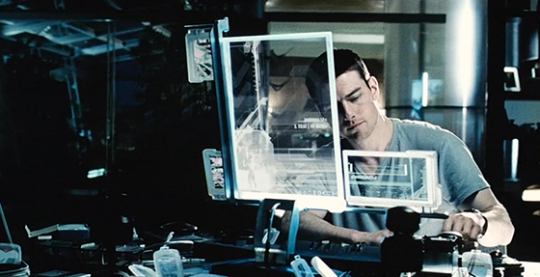
Furthermore, some fictional narratives are performative, meaning that their fictional existence allows technological innovations from science fiction to become a reality in our material world. This clearly shows that narratives are far from neutral and have a significant influence on our societies.
Apple is said to have drawn inspiration for its touchscreens from the touchscreens featured in the science fiction film Minority Report.
« We are living off expired or expiring stories. »
« We are living off expired or expiring stories. […] They are lethargic or stuck, they can’t move things in generative ways anymore, but we often feel we cannot let them go. Many of these expired stories give us a sense of security, purpose, and direction - precisely because they seem stable and solid. Thus, we become attached to them and get used to their weight in our lives. If we notice they are dying, we refuse to accept it and we put them on life support because we fear the void left in their place when they are no longer there. » Hospicing Modernity, - Vanessa Machado de Oliveira
Vanessa Machado de Oliveira, in her book Hospicing Modernity, observes that we live in obsolete narratives. These narratives, which shape our dominant imaginaries, can be referred to in different ways. For her part, she uses the expression ‘modernity/coloniality’ to refer not to an object or a concept, but to a collective, living, multi-faceted story that has a profound impact on and shapes our societies. She denounces its ravages and proposes that we collectively prepare ourselves to live without these narratives, which may seem reassuring but are in fact destructive. In doing so, she highlights the need to find multiple approaches to building collective emancipation in order to co-construct and find alternative collective narratives rooted in values of care and cooperation.
Fundamental :
After presenting some broad outlines of what narratives and imaginaries are, and showing how they shape and influence our societies, we can see that certain dominant narratives today are completely out of step with socio-ecological issues. Yet these issues relate to physical and material realities that are scientifically established and already at work. Therefore, interest in alternative imaginaries and prospective scenarios may appear to be an obvious necessity.
Extra :
To learn more about the impacts of science fiction and their political implications :
To learn more about how stories impact and shape our societies:
Dans les imaginaires du futur[9]
Série de Blast - Planète B[11]
Hospicing Modernity: Facing Humanity’s Wrongs and the Implications for Social Activism[13]