Transition(s) 2050, scenarios from ADEME
Unable to reach the audio or video resource at the address:
The resource is no longer available or you do not have the rights to access it. Please verify your access then recharge the video.
ADEME has developed four scenarios called Transition(s) 2050.
Each one answers the question: how can France achieve carbon neutrality by 2050?
They offer different approaches and methods for achieving this goal. Each scenario outlines socio-political trajectories based on different guiding principles.
About ADEME
The French Environment and Energy Management Agency (ADEME) is a French public industrial and commercial institution whose mission is to initiate, promote, coordinate, facilitate and implement environmental protection and, above all, energy management initiatives. It was created in 1991 to replace the AFME and has also been known as the Ecological Transition Agency since June 2020.
Creating scenarios
« ADEME wanted to put forward four coherent ‘standard’ paths for discussion, deliberately presenting contrasting economic, technical and societal options for achieving carbon neutrality by 2050. Designed for mainland France, they are based on the same macroeconomic, demographic and climate change data (+2.1°C in 2100). However, they take different paths and correspond to different societal choices. This work was carried out between 2019 and 2021. However, the Covid-19 crisis and the conflict in Ukraine do not call into question the assumptions or conclusions of the work presented here. On the contrary, they reinforce them by demonstrating the benefits of moving away from fossil fuels and promoting energy efficiency. » (From the ADEME website)
Themes and parameters used
The scenarios are detailed according to four sectors:
Consumption trends: Land use and urban planning, Residential and commercial buildings, Passenger mobility and freight transport, Food
Changes in the production system: Agricultural production, Forestry production, Industrial production
Energy production: Gas mix, Cooling and heating, Biomass, Liquid fuels, Hydrogen
Resources and carbon sinks: Waste, Resources and non-food use of biomass, Carbon sinks.
The objective of this exercise is therefore to: construct internally consistent scenario profiles to illustrate the range of long-term options for achieving carbon neutrality and explore their various implications inform the essential short-term decisions.
They are based on an assumption of population growth between now and 2050.
The following parameters are used:
Energy demand
Consumption of irrigation water, construction materials, agricultural inputs and land use
Waste production and management
Energy production and energy mix
Imports and exports
Greenhouse gas balance and biological and technological CO2 sinks
Fundamental : Incompatible!
The following four scenarios are not compatible with each other. Each scenario has been designed as a strategy for achieving carbon neutrality by 2050, based on strong and distinct assumptions. It is therefore important to understand that each scenario must be considered as a whole, and not to assume that certain parts of one scenario are compatible with certain parts of another scenario.
As the themes of each scenario are all interconnected, it is not possible to envisage a relationship with food as described in Scenario 1 and a relationship with mobility as described in Scenario 4 and hope that this will lead to carbon neutrality in France by 2050.
Scenario 1 - Frugal generation
The transition in this scenario is based on strict constraints on consumption. A protected relationship with nature and an economy based more on social ties than material goods are particularly valued in this scenario. These constraints are reflected in significant reductions in energy and material demand. International ties are weakened in favour of local ties.
Here, carbon neutrality is achieved solely through natural carbon sinks: forests and soils.
The relationship with technology is rather low-tech: focused on cultivating repairability and technical user-friendliness.
Scenario 2 – Territorial cooperation
The transition in this scenario relies on societal changes that involve shared governance. Significant investment is directed towards efficiency and renewable solutions. Nature conservation is institutionalised and highly valued. This scenario emphasises equity and the end of economic growth as a societal goal.
Carbon neutrality is achieved almost exclusively through natural carbon sinks.
The relationship with technology is strongly linked to issues specific to each territory, with great importance given to the local level.
Scenario 3 – Green technologies
The guiding principle of this scenario is technological development. Ways of living, working and spending time are almost identical to current French lifestyles. The French government is planning societal changes in a context of international competition and globalised trade.
Carbon neutrality is achieved solely through existing technologies for capturing CO2 at the chimney outlet.
The relationship with technology is focused on technological progress and high-tech innovation.
Scenario 4 - Repairing bet
This scenario allows for unlimited consumption, pursuing a resource- and material-intensive economic model with a focus on developing technologies for adaptability and repair in the face of climate change. The aim is to reduce inequalities and improve international institutional cooperation on climate issues. This approach seeks to rely on solutions such as digital technology and other technologies that are not yet fully mature.
Carbon neutrality is only achieved through CO2 capture technologies, which are currently in the pilot phase.
The relationship with technology is embodied by a technical solutionism approach.
Summary
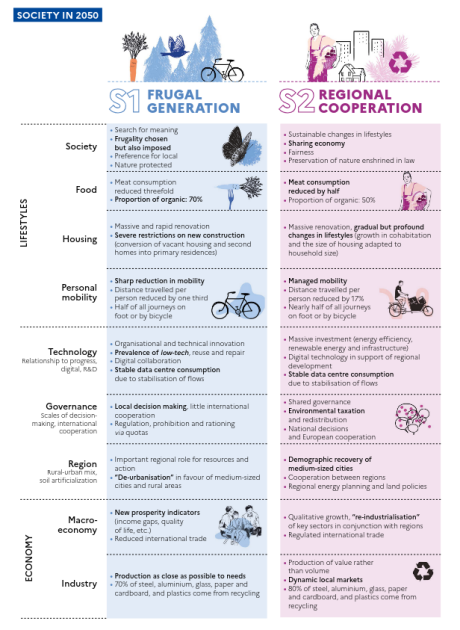
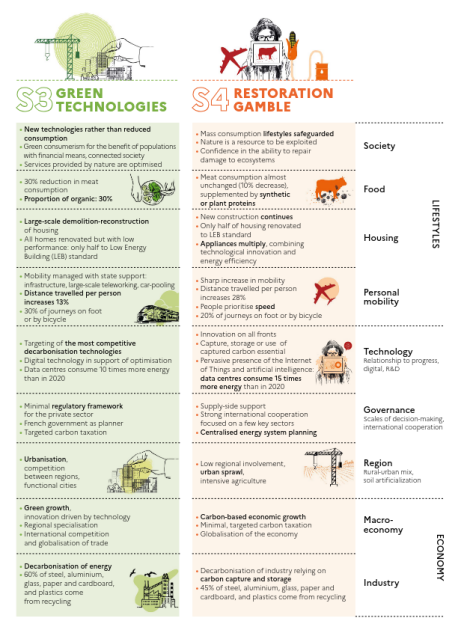
Variations in the role of the engineer according to different scenarios
S1 : Low-tech engineering
In this scenario, technical issues – relating to design and repair – are becoming more widespread, enabling more and more people to get involved. Engineers could therefore play a facilitating role in this technical transition, drawing on their socio-technical expertise, and focus their energy on promoting understanding, maintenance and deployment of technical systems to make them as accessible as possible.
S2 : Territorial engineering
Engineers can play a leading role in regional cooperation issues by informing collective decision-making with their technical and scientific expertise. They do not make decisions alone, but rather work to address regional issues by providing expert insight into technical challenges.
S3 : Techno-optimistic engineering
Engineers may play a role similar to that of the dominant image of engineers today, focusing most of their energy on complex, large-scale technical systems such as renewable energy, electric cars, etc. They focus their energy on technical solutions to maintain lifestyles in 2050 that are similar to those in 2025, but with technological changes to move towards more carbon-free technological uses.
S4 : Technological solution engineering
In this scenario, technological habits and practices change little compared to those adopted today. The goal of carbon neutrality would be achieved through a technological gamble. Engineers could therefore play the role of inventors, searching for technical solutions to capture large quantities of carbon emissions. This scenario is part of a very technocratic and techno-solutionist worldview.
Choosing to work on one scenario rather than another is a political choice with specific socio-environmental consequences. Equipping engineers with scenarios means placing them in the position of ‘scenario engineers’, aware of their roles in the socio-technical trajectories they are mapping out through each of their choices.
Extra :
For more information about ADEME, visit the official website: https://www.ademe.fr/en/futures-in-transition/scenarios/